Monday, 21 July 2014

The Power of Kroll

I was never a fan of season sixteen. I enjoyed The Ribos Operation and The Pirate Planet but I felt the others were a bit to slow and dull for me. I rewatched The Power of Kroll recently and my opinion of this story changed dramatically. I think the pacing is slightly off, it is fine but it could be a little bit more pacey.

The acting in this story is top notch. Mary Tamm is phenomenal as Romana, Tom Baker's performance has clearly been toned down and therefore this story is not another Tom Baker comedy half hour which some of this season could be accused of. The other performances are strong including Phillip Madoc's latest classic performance. The Kroll effects are brilliant in this story. To me this rivals some of the effects they were doing in Season Twenty Six with The Destroyer.

The rest of the production is brilliant. The location shots add another dimension to the show. The sets seems of a much higher standard than what they were the season before. I do not normally comment on this but I found the costumes in this very good. Mary Tamm's costume is very good and I am impressed by the outfits worn by the Swampies.

Robert Holmes produces another strong story, enhanced by very strong production values, just a little more pace would have made this a great story.

8/10

Saturday, 19 July 2014

The Girl Who Waited

A powerful moving story at the heart of series six part two - The Girl Who Waited. Series Six Part Two is probably my least favourite part of the Matt Smith era but there are a few really good stories in this era, this one being one of them.


The Girl Who Waited begins with an ingenious idea and uses it to create a compelling story. The writing is very strong in this story, which is key to the stories success. The writing is then brought to life by some great performances. This story is about Amy and Rory, so much so that there is practically no guest cast and The Doctor is sidelined for much of the story. Karen Gillan and Arthur Darvill both give the performances of their lives making the final few scenes very emotional. On top of this you get the debate on which Amy would you choose. We know that the young Amy will be saved but it is interesting to watch the characters debate this.


The Handbots were an interesting creation for this story. It is very unlikely that we will see the return of the handbots but they were a good enough creation to add menace to this story and were beautifully designed. Finally this story looks visually amazing, some of the visual effects used in this story are some of the best ones scene in series six.

In summary a compelling moving piece, beautifully made, beautifully performed.

9/10

Saturday, 12 July 2014

The Macra Terror

Last year Doctor Who fans were blessed by the return of nine completely missing stories from The Second Doctor era back to the BBC. The lesser known of the two was The Enemy of the World. The Enemy of the World had never received much appreciation from fandom due to the fact it is overshadowed by everything else in that season and that five parts were missing. In the recent DWM poll it was the most improved Doctor Who Story which is such a testament to how under appreciated the lost stories of this era are. I had always loved The Enemy of the World, even before it had been discovered and I was only really able to listen to the soundtrack; The Macra Terror comes into a similar category as The Enemy of the World.

The Macra Terror feels forgotten by Doctor Who fans. The only thing people really remember from it are The Macra, namely due to their surprise (and welcomed) return in Gridlock. These were the third monster (following the Daleks and the Cybermen) to feature in the series and then come back. They are interesting monster and it is a shame we cannot see the original story as despite the fact they probably may have looked quite clunky they are actually a very good monster.

The story sees the TARDIS land on an Earth colony (like The Power of the Daleks three stories before this). The first episode portrays this happy jolly perfect place where the companions are very willing to stay at. However as we delve deeper into the story we realise that the place is too perfect and that there is something deadly going on. By episode three we learn how The Macra had infiltrated the workings on the colony and now are controlling the entire thing. There is a funny scene in Episode Four were the narration between segments of the soundtrack states that the Macra control buttons and controls with grace - I suspect it would not look like that but I leave that up to my imagination.

This is probably the best story for the Polly, Ben and Jamie trio as Jamie feels forced on in all the stories prior to this (as he was) and in the following story Polly and Ben are hardly in it. It is this story however we begin to see the transition from the nervous Scot to the Jamie which we know of from seasons five and six. Ben is very good in this, despite being controlled for a couple of episodes. All three serve a purpose and work well here. Patrick Troughton is now firmly comfortable in the roll now and it seems like The Moonbase has calmed this Doctor down into the typical Second Doctor.

Unfortunately I cannot add much more since we do not have the complete visuals to be able to analyse production and direction but this is a thoroughly enjoyable story bringing about an interesting monster and giving the companions very good treatment. It is so good to listen to them having so much fun in episode one whilst The Doctor investigates. It is this and Fury from the Deep I want back next. Both these stories I suspect will jump up greatly in fandom and will receive the respect they deserve.

9/10

Friday, 11 July 2014

State of Decay

About a month ago I ran a poll on the blog where I listed the last few stories which I am yet to see and I promised that the winner will be reviewed and the winner was State of Decay. I have to say Season Eighteen is a weakness of mine, I have seen a couple of stories but not all. I have however seen Logopolis and this story firstly highlights how little the production team probably knew about the show. Logopolis is unlike any other Doctor Who story from the Tom Baker era. It is not celebration but a funeral. State of Decay on the other hand would have been the best choice to end the Fourth Doctor's tenure. It combines all the main elements of the three producers eras from gothic horror to cold hard science. What a shame!

One of the strongest features of this story is the script. Terrance Dicks knows how to write a good solid Doctor Who script and this is what the eighties seemed to lack.  The script feels like a very traditional Doctor Who story, especially that first episode. This story could have very easily slotted in during season thirteen or fourteen. The first episode is excellent, I cannot fault the script there at all. Various interesting threads are set up whilst evoking a compelling atmosphere and tone. I am glad that the director got rid of Christopher H Bidmead's rewrite of State of Decay and kept Terrance Dick's original since I do not want to know what this story would have been like if Bidmead had given it an unnecessary scientific and mechanical edge to it.

The problems to me with the story are not from the script point of view but the way State of Decay has been brought from script to screen. Some of the performances are not great. The rebels are a bit dull, totally pathetic. The vampires become totally melodramatic by part three. Some of the effects are not well realised such as The Great Vampire and personally the direction is not great. If this had been produced in 1976 with Robert Holmes script editing the script, working with Dicks, alongside the direction of Douglas Camfield or David Maloney, I suspect we would have had a great story but unfortunately the production does seem to let it down here.

The primary cast are very good in this. The scenes and exchanges between The Fourth Doctor and Romana are particularly compelling in this story. K9 is sensational in every scene - as usual. Adric is not really given a chance, almost like the script had been written without him and he had to be added in later. This is a shame as having watched Logopolis I realise the potential that there was between The Fourth Doctor and Adric but this was not the case in State of Decay.

In summary, this is a story with bags of potential! It is such a shame that this script was produced for season eighteen not season thirteen as I suspect we would have had a much greater story back then. The production and direction do let this story down but it is such a relief to have such a traditional script after Season Seventeen and the seasons to come. This should have been Tom Bakers send off but alas not.

7/10 (Some very good bits but let down)

Thursday, 10 July 2014

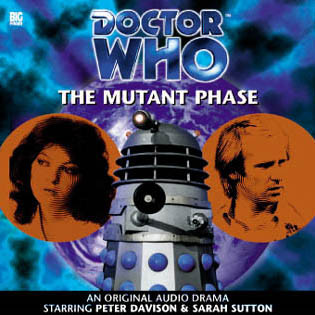
The Mutant Phase

I was planning to review Eye of the Scorpion which I am currently listening to but I am only halfway through it at the moment so I am going to review The Mutant Phase which is another older Big Finish story which I have listened to recently.

I did not know what to think of this story during the first two episodes. It seemed to me a story that I could take or leave. It set up a lot of mysteries and threads, so many I believed that the story would fail to answer them. Episode Three was a massive change to me however. The story began as this pretty small scaled story featuring a base full of humans fighting for survival due to some mysterious events which had happened on Earth but when the story began to tie things together and moved onto Skaro I was really impressed. The scenes of Skaro, especially those featuring The Emperor Dalek totally gripped me and I was so desperate to hear what happened next.

The actual super mutant Dalek idea I found was quite interesting. The idea that the Daleks are evolving into something new and they do not like the new form foreshadows Robert Shearman's Dalek which was to come. The story also moves into morality territory which I really liked. It felt so reminiscent (but I do not think that is the word) of the current Eight Doctor Adventures. The Eight Doctor probably has the greatest morals of all The Doctors, he will not throw away the life of another to stop something, to him it is not a 'numbers game' which many other Doctors were more like (The Seventh Doctor, The War Doctor). The Fifth Doctor is very similar in this. He works with the Daleks reluctantly to stop a greater force. Having listened to both this and Dark Eyes Two: The Traitor one may think that Big Finish are running out of ideas but this does not bother me.

The performances overall are very good; the characters are quite bog standard, nothing special or particularly memorable about them, they are just there. The Daleks are good in this.

In summary slow start which sets up so many threads which tie together beautifully in a timey wimey morality story featuring some cracking scenes and ideas which come into being in the second half.

7/10

(PS. 7/10 means to me a pretty standard Doctor Who Story, this is why so many of my reviews have resulted in the stories resulting in seven. In future use this as a guide, anything above seven is great in my opinion but anything below seven is not so great in my opinion)

Wednesday, 9 July 2014

The Dalek Invasion of Earth

Personally this story is revolutionary. Firstly Terry Nation secured the future of the Daleks - up till this point the Daleks had been seen as these racist entities living in their city but now they are an all conquering galactic superpower, the Daleks here are the template for all Daleks afterwards. Secondly this story saw the first ever companion departure which I will comment upon later. Thirdly I think this story marked a massive change in tone for the series. For the first season and Planet of the Giants it felt like the Sydney Newman Master Plan but this story was the first story personally where the Doctor Who which we know and love came into being. Season Two was the transition between the original intentions of the show in Season One to good old Doctor Who of Season Three.

Now onto the story. There is something about this story as there are constant references to it (Remembrance of the Daleks, The Stolen Earth...). Furthermore Big Finish have gone to this period on several occasions and it seems that they are going to return once again to the 22nd century occupation in Masters of Earth.

This was the second time I have ever watched it and the first time I watched it I hated it. I thought that there was so much potential but it was wasted by poor performances and an overlong boring script but I am pleased to say that on this occasion my opinion has changed...

There is a lot of scope to this story. There is a constant change of location as the characters (like a normal First Doctor Dalek Story) are chased out of the original location into another (this time without a TARDIS). I have a lot of respect for the set designers who had so little money and produced this!

Overall there are a lot of good characters, the performances are not quite there but are fine for the most part. The Robomen are an interesting creation and I like how they have in recent years returned firstly during Dark Eyes Two and Lucie Miller/To The Death along with the Dalek puppets in Asylum of the Daleks and Time of the Doctor (these are essentially the re-imagining of the robomen). William Hartnell is spot on as usual but I am not totally convinced by his companions but in all honesty I think they all give some of their best performances. The story is possibly one episode too many but unlike the original Dalek story, I am not bored. 

7/10

Thursday, 26 June 2014

Silver Nemesis

After being really impressed by The Curse of Fenric yesterday, I decided to delve deeper into the Seventh Doctor's era, this time to another story to feature The Seventh Doctor and Ace. Silver Nemesis is the Twenty Fifth Anniversary Special and unfortunately that is its problem. It does not feel like a special. There are Cybermen, they needed to be there for the Silver anniversary, but apart from that there is little tribute to the shows history. This is a real shame as JNT put so much effort into The Five Doctors and possibly something similar would have given the show the publicity it needed to support the show during its darkest hours.

The other thing is that the story is not that original. It is the exact same story as in Remembrance of the Daleks but with Cybermen not Daleks (some ancient Timelord object being hidden by The Doctor that lots of people are chasing after The Hand of Omega and Nemesis). Other problems include the American tourist, the social worker hating people and the Cybermen's allergy to gold.


Now that was all that was bad about Silver Nemesis now the good. It is action packed from the beginning and the action scenes are very gripping. The Cybermen look brilliant, the best looking version of them in colour. Lady Peinforte is a very intriguing character and The Doctor and Ace are electric together. It is a very fun story and thus enjoyable. The Doctor is so mysterious in this story and I love the time travel element.

This is a fun enjoyable story with a couple of flaws in the writing but the main problem is that it is such a missed opportunity and it is clear that it is a missed opportunity by the constant subtle references to the past but nothing there to really celebrate (but The Doctor and the Cybermen).

7/10

Wednesday, 25 June 2014

The Curse of Fenric

Alongside Remembrance of the Daleks, this story marks the peak of the renaissance Doctor Who experienced in the late 1980s with the Andrew Cartmel Masterplan coming to fruition. It also serves as probably the darkest Doctor Who story of all time. Additionally it is a major story as all of The Seventh Doctor adventures which would follow on in the Virgin New Adventures and Big Finish Doctor Who Monthly Range which featured The Seventh Doctor used this story as the foundations of the new direction they would later on take the show.

This is a great story but also a clever story. Having seen this a few times now I can really appreciate the amount of work that was put into the writing of the story. It is not you bog standard good solid Doctor Who of the sixties and seventies. A lot of work has gone into this script by the writer. The story is rife with symbolism (baptism, undercurrents, chess...) all adding to the effect the writer is trying to have.

I must turn to Ace, the most important character of the whole story. Sophie Aldred gives the performance of a lifetime. The production team have created this revolutionary character, someone all the companions of the modern era would later follow. This is the story where the character grows up. She is no longer the pyromaniac teenage mess ('social misfit' one might say) but now an adult who has gone through significant change when she is forced to face up to her past in a more subtle and effective way than they had tried to achieve in Ghostlight. This change is symbolised by her baptism at the end. Initially this story was to come first in the season but I am glad that they changed the order as season twenty six works brilliantly in this way. Battlefield and Ghostlight foreshadow the great changes to come for the lives of the main characters, Curse of Fenric is the big change and Survival is when The Doctor puts Ace back in her home setting to emphasise how far she as a character has come. If the original order had been the way it was released, I do not believe the effectiveness of either this or Survival would have been as present as they are like this.

Speaking of The Doctor, this is one of Sylvester McCoy's finest outings. He is dark, Machiavellian and manipulative. He is playing the game of chess against Fenric from the beginning, moving characters into place at the right time. This is the darkest we have ever seen The Doctor, when he emotionally cripples his companion just to defeat Fenric. The Seventh Doctor is so different from his successor whose morals would prevent him from doing anything (Dark Eyes Two - The Traitor) but The Seventh Doctor is ready to do anything to get the job done.

The darkness of The Doctor is reflected in the darkness of the story. The production team could have just set this in Nazi occupied Europe or Nazi Germany itself but by having it set in Britain. Having the secondary villains of the story to be the British adds a whole new dimension to the story. They emphasise how powerful and evil Fenric is, as if Millington who would drop disastrous chemical bombs to incinerate Dresden or Moscow is just the secondary villain, how evil must the main villain (Fenric) possibly be?

Thinking about this story in context also adds another dimension to it as the story may be set in The Second World War but is more about The Cold War. The beginning and the end of the war are both shown in this story. It is important to remember that this came out in late 1989 - the end of The Cold War. Most of the people watching this story would not know why there had been so much international tension between the USA and USSR. The Curse of Fenric is an allegory for all wars but especially The Cold War. The soldiers are the pawns who fight for their political leaders. It is only when the pawns work together can such a conflict end. Gorbachev came from a rural background, he at the beginning was no longer a pawn in Stalin or Khrushchev's chess matches against Kennedy, Johnson or Nixon, but by people working together conflict can end. This happens here when Bates and Sorin stop fighting and work together.

Fenric himself is a strong villain and the haemovores were the last great monster of the classic series. The Eighties were so over reliant on returning monsters that there were very few great new monsters coming about - the haemovores sadly would not make a televised return but were absolutely great monsters.

The Curse of Fenric is an allegorical, character driven, great story. The care and attention that went into both script and production is monumental and as a result produced one of the finest stories of the 1980s rivaling The Caves of Androzani and Remembrance of the Daleks. It is a shame that the show did not continue on television into the 1990s as this dark approach worked brilliantly here. The problem with the whole story though is that it does take a couple of watches to understand as it is very complex and needs some thinking. The fuel for the end of the original run of Doctor Who had been laid ages ago but stories such as this and Ghostlight are so complex that the casual viewer just did not know what was going and thus turned off. If the show had never come back in 2005 my opinion of this story may have been tainted by that fact; but it did come back. The Curse of Fenric burned away the old order and set up the new so we can have a new series. The show at this point had to go away but this is definitely the right way to let it go...

10/10

Friday, 20 June 2014

Destroy the Infinite

The Eminence has been introduced to us in The Seeds of War, Dark Eyes Two and will return in Dark Eyes Three but Destroy the Infinite brings about the long awaited story where The Doctor first encounters The Eminence. The Fourth Doctor Adventures (as mentioned in the previous review of Last of the Colophon) are meant to be nostalgic but this one breaks this idea completely. This does not feel like it came from 1977 at all. The space opera genre is a terribly underused genre in Doctor Who; I would not say there was a single space opera in the entire of the Tom Baker era (the only stories I can personally say are space operas to any extent are The Dalek's Master Plan, The Space Pirates, Frontier in Space, A Good Man Goes to War). This is why it is so strange, BUT that is no problem here as the story is excellent.

This story is really a story of two halves. The first half is the desperate struggle for survival, the resistance movements, the reign of the Eminence. The second half is a war story. In the extra features Nick Briggs (writer) talks about a series of war films which inspired the plot but he did not mention Star Wars at all - surely people could see the similarities between the small fighter ships attacking The Infinite here and the small fighter ships attacking The Death Star. The various references to war stories in here add a new layer of scope to the entire story.

This story feels epic, the scale of the adventure is huge - surprising for such a small cast. The writing, direction, performances and soundscape are responsible for this. The performances are strong all round and like what I am becoming accustomed to with these recent Fourth Doctor Adventures it ends with The Doctor giving a moral speech about victory and celebrations in a war. In the words of Captain America (Avengers Assemble) "When I woke up they told me that we won, they never said what we lost", such ideas are prominent in this memorable closing speech.

Overall a brilliant story. Big Finish have been excellent at developing brilliant new characters (Charley, Lucie, Klein...) but until very recently never developed a successful recurring villain - The Eminence is the great Big Finish alien that we have been waiting for!

9/10

Tuesday, 17 June 2014

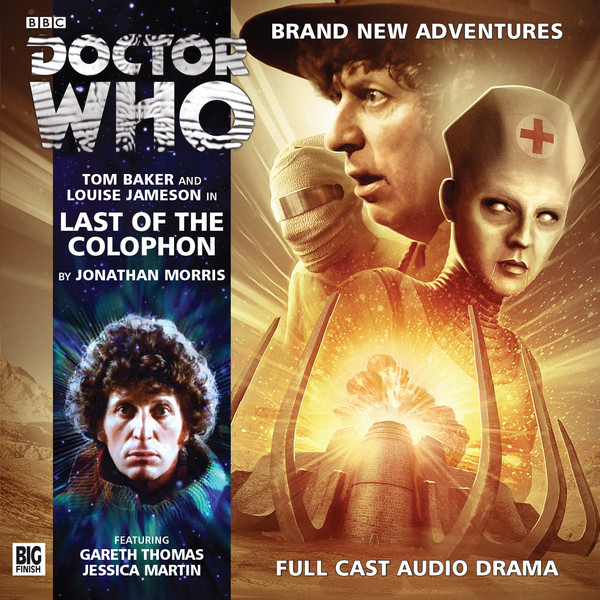
Last of the Colophon

One of my biggest problems with the third season of Tom Baker audios is that, unlike the first season with Leela, it did not feel that authentic to the time. It felt too modern. The Seventh Doctor is for dark, complicated stories about The Doctor taking on Gods and Monsters, The Eight Doctor's era is about the chaos which makes a good man go to war but I want the Fourth Doctor Adventures to be authentic. Last of the Colophon does not disappoint.

I guess the brief to the writer must have been 'think of a classic science fiction or horror film that Doctor Who did not cover in the 1970s (an idea eluded to in the behind the scene features) - The Invisible Man. This story is so authentic, using different themes and ideas from the mid 1970s, I spent most of the release wondering which story this part reflected (Hand of Fear, Planet of Evil...) as well as enjoying this release.

The main problem with the story is that a few elements are quite predictable. From the beginning we can infer that Morax has something to do with the end of his species and that he is not entirely good, just from his relationship with the sadistic nurse.

The characters are good in this, nothing special, nothing memorable but good enough to keep the story flowing. Overall I really enjoyed this release, mainly due to how authentic it is. I may not have been able to have watched Doctor Who in 1977 but it brought my mind back to that era, hopefully there are more stories like this to come.

8/10

Sunday, 8 June 2014

The Power of Three

This is Matt Smith's final happy adventure with Amy and Rory before the end and it is filled with great characters, a lot of fun and the return of one of Doctor Who's biggest allies - UNIT.

Amy and Rory are very strong in this story, we learn a lot about them as characters - fitting since it is the penultimate episode for the companion who has featured in the most episodes. The story highlights how alien The Doctor is and Matt Smith is totally faultless (as usual) here. We have two new characters who have only just been introduced recently and they are amazing. Firstly we have Brian, returning from Dinosaurs on a Space Ship. He is brilliant in this story, who has some very emotional scenes with The Doctor, when he is concerned with the safety of his son and daughter in law. They are so sad when you have the hindsight of the following weeks story. I wish we had more adventures with Brian, Mark Williams is extraordinary in this.


The other new character is Kate Stewart, who I hope will become a recurring character in The Twelfth Doctor's era. She just steals every scene from Matt Smith, which is a huge achievement knowing how great Matt Smith is in this story.

UNIT return in this story under Kate Stewart and I do hope we see a modern day UNIT family develop under Steven Moffat. My main complaint of RTD era UNIT was that there was never a consistent UNIT leadership. UNIT Captains changed every week. I hope when UNIT does return again, this does not happen.


This is a fun story but unfortunately does not end as well as I had hoped. It is very rushed with lots of different ideas unexplored - who were those nurses and why were they taking people to their ship. The problem with the monster is despite the fact the Shakari is very intriguing, this story seems to be a missed opportunity for the return of the Kraals (a scientific experiment to investigate the best way to take over the Earth - the same as The Android Invasion). This story really could have done with being a bit longer, just to have more time to work on the ending.

Enough with complaints a very strong story with just a lackluster ending. It is a shame that Rory is gone as I suspect we will not be seeing anymore of Brian but I do hope that Kate Stewart does continue on through Doctor Who (she has appeared twice now, but I hope for more).

7.5/10

Thursday, 5 June 2014

Doctor Who Legacy - Season Five

We did a review of the game in general but it is a topic too large to cover in a small review. Furthermore the Doctor Who Legacy content has been by far the most viewed content on the site, so I decided that it a review of Doctor Who Legacy Season Five would be the best thing to do. We are going to continue reviewing the game, as more additions take place.


The season begins very much where Season Six left off. We venture through a series of Christmas based levels which lead to The Time of the Doctor (which was included despite the fact that it is actually in season seven). There is some impressive artwork in these levels (The Forest of Death levels especially). The characters which drop in these levels had come from the advent calender series last December.


The story itself is very good and I am looking forward to see how it progresses in future levels. The designers recently stated that they 'look for the episodes which provide the best opportunities for varied gameplay (i.e. with lots of potential threats to deal with).'. It is a shame therefore that The Pandorica Opens was not included with this but they have chosen a good selection of levels: The Beast Below, Victory of the Daleks, The Time of Angels/Flesh and Stone, Vincent and the Doctor. I really liked the Vincent and The Doctor level, this episode highlights the amount of effort the creators put into making this game (the gems have extra skins). 

As we progress further into the games we see the games true aims and ambitions come to fruition. Season Seven is effectively a line up three game, it is there to introduce you to the game. Season Six just powers up your characters ready for Season Five. Your characters do not level up any more (they will begin to level up in update 2.2 coming soon). This really is a strategy game. The gameplay has been made so complex that you can no longer pass levels through just lining anything up.You need to think, you need to choose characters with the correct abilities, you need to choose perks wisely. The perk system is the only thing that allows you to get through Season Five, since the enemies become increasingly powerful whereas you cannot level your characters up anymore.

There are also a few extra features in Season Five which are really nice touches. March of the Adipose just makes you smile; the Roger Delgado Master is met in Tarminster - setting of parts of Terror of the Autons, that is a really nice touch. I do wonder if the Autons themselves will be added to the game in the future. John Simm's Master has the Toclofane, what if the other Masters have allies of their own (I do not think The Master's Adipose army will probably cut it).

Speaking of Timelords, we have four new Doctors in Season Five. John Hurt's Doctor drops early and his abilities are very good, but the best one of all is my personal favourite - THE SECOND DOCTOR - his abilities make him a very powerful Doctor (a massive help when fighting the reapers in the final level Paradox of the Zygons).

In summary this is a very strong addition to the game, and I do hope that the future looks as bright as it seems here.

Wednesday, 4 June 2014

Daleks in Manhattan/Evolution of the Daleks


Another poorly regarded story that I have personal affection for (mainly as this was the story that turned me into a doctor who fan).

Trying to work out why this story is poorly regarded I must point the finger at the acting. Miranda Raison's attempt to do an American accent is not brilliant and unfortunately becomes a bit over the top. Personally I can stand it, thus the character is not much of a problem.

Despite her failed attempt at an accent, I do like the character of Tallulah. I think her acting is fine (it really is just the accent). All the other characters I really liked Solomon is very good as well as Frank (Andrew Garfield has done well since) is very good, Lazlo is also very enjoyable.

The production of this is very good and it felt more like a real representation of New York than Angel's Take Manhatten which was filmed there. It looks brilliant. The Tenth Doctor and Martha are both especially strong. Personally Martha beats Rose and Donna hands down. The main thing I did not like was the reference to Rose in part two. Having watched series three recently I have noted that with only two exceptions (42 and Blink [it is inferred in The Lazarus Experiment - she is very much referenced in the subtext]) Rose is referenced in every story.

Finally we move onto the Daleks themselves. Victory of the Daleks is Power of the Daleks and this is Evil of the Daleks, several key elements cross over from that story into this - humans being given The Dalek Factor, humans being given Dalek genes and ideas. This story does feature two of the all time three greatest Daleks. The best is The Special Weapons Dalek (Remembrance of the Daleks and Asylum of the Daleks) but coming runners up are Dalek Caan and Dalek Jast - two Daleks who have to swivel their eye stalks around in the sewers to check they are not being watched so they can have a conversation about Dalek Sec in Evolution of the Daleks. The attack of Hooverville is very good (I feel so sorry for the actors who had to stand in the cold and the rain to film this sequence). The murder of Solomon highlight how cold and emotionless the Daleks are, further emphasised by Dalek Sec Hybrid. Again I do not have much of a problem with Dalek Sec Hybrid. It did not go beyond the story and I liked the idea how there were experiments and the Daleks chose purity over survival - it emphasised the racial ideas of the Daleks, something which the new series has hardly touched upon: these things are allegories of Nazis after all. The Pig Slaves serve their purpose, they are not memorable but they seem to be like robomen but these Daleks do not have the technology to build an army of robomen. The only problem I have with the Daleks are that everytime we see them in the new series The Doctor says for one reason or another 'That makes them deadlier than ever'. If they are deadlier than ever why can't you just show it? The attack of Hovoerville did showcase this, but can Daleks stop just shouting EXTERMINATE on the spot and not firing.

In summary a good solid, heavily underrated story. Can Doctor Who Fans just overcome small problems in production such as accents (British people are never going to pull of the best American accents, they are credible enough to get away with it so accept it) or CSO in Underworld, and ignoring the story that they are in. This story is a fight for survival. The Daleks are more like Daleks in this story than any other story in the new series. They are remorseless, clever, manipulative, Nazis - like they were back in the 1960s. Ironic really when the main Dalek wanted to change all that. Overall a solid:

7.5/10

Tuesday, 3 June 2014

The Caves of Androzani

Robert Holmes rewrites a few of his old scripts, enhanced by Graeme Harper's revolutionary direction, creates something beautiful. Falling from first in the top 200 to fourth in The Fifty Years Poll, I decided that it was the right time to have another look at this classic story.

From the beginning the set up is great, an endless bitter war, a society that has been corrupted by greed so now (apart from The Doctor and Peri) there are no truly good characters. We have Sharaz Jek - a man who has been warped by the cruel treatment he received Morgus that he has been forced to isolate himself from beauty in the caves and carry the scars; we have Morgus - a greedy manipulative egocentric man who is prepared to kill in order to ensure his own prosperity; General Chellak - a man who will follow all orders, even if they go against his own opinions, and use that as an excuse for his actions (reflecting the Nazis at the Nuremburg Trials); Selateen - a man who may appear good but rejoices in Peri's misfortune as it ensures his own survival; and the gunrunners - who fire upon their own men and are just after the money. Even the secretary is evil, discrediting Morgus so she can take over the company and become more powerful. Holmes creates a hopeless world, populated by some of the most egocentric characters ever to be depicted in Doctor Who.

Along with the cast we have the revolutionary direction used by Graeme Harper. The direction here, goes against all the camera work norms enabling the story to have a fast pace which revels Douglas Campfield himself. This revolutionary directing shows how the show is evolving and foreshadows what it will become.

The tension is brought to breaking point and the only thing which could have made the situation The Doctor faced worse would of been to have had the queen bat's chamber to have been filled with the gas which The Fifth Doctor is allergic to.

In a story where only Peri survives (not even The Doctor makes it out of this one), it becomes a disaster move from the outset - not just any action adventure serial. Holmes' rich script enabled Peter Davison to really showcase his acting at it is faultless in this story. I have many problems with parts of The Fifth Doctor era but this story is truly a classic. It further highlights the benefit of having a single companion with The Fifth Doctor, this is the only story in his era to do so - possibly this inspired Big Finish later. Not forgetting Peri here who goes beyond the atypical screaming companion with Nicola Bryant's exceptional performance in the scenes with Sharaz Jek.

This story is truly a classic. The greatest Doctor Who story of all time? No. There are others which have something else, this is just a faultless story but it is just missing something to elevate it to that position in my opinion. The best regeneration story of all time? Possibly. It will always be between The Caves of Androzani and The War Games. Personally it is The War Games but that is probably because I am a Second Doctor fan. Despite all this, it is a classic. A fitting end to The Fifth Doctor's era.

10/10

The First Fifty Years Poll

Recently Doctor Who Magazine has done it's First Fifty Years Poll and I personally like how this one went more than I did the Top 200 Poll. Now we are not going to publish a full list since you should all get the magazine and read it but we are going to compare the top fifteen of this poll and others.

First Fifty Years
1 The Day of the Doctor              
2 Blink                                    
3 Genesis of the Daleks     
4 The Caves of Androzani            
5 City of Death                    
6 The Talons of Weng Chiang  
7     The Empty Child/The Doctor Dances    
8 Pyramids of Mars
9 Human Nature/Family of Blood  
10 Remembrance of the Daleks 
11 The Robots of Death        
12 The War Games                      
13 Bad Wolf/Parting of the Ways      
14 Terror of the Zygons                  
15 Dalek              

Top 200                                  
1 The Caves of Androzani            
2 Blink                                      
3 Genesis of the Daleks              
4 The Talons of Weng Chiang
5 The Empty Child/The Doctor Dances
6 Human Nature/Family of Blood    
7      Pyramids of Mars  
8 City of Death                  
9 The Robots of Death          
10 Bad Wolf/Parting of the Ways
11 The Girl in the Fireplace      
12 Turn Left                                    
13 The Stolen Earth/Journey's End  
14 Remembrance of the Daleks    
15 Dalek        

Personal
1 The Invasion
2 The Sea Devils
3 Remembrance of the Daleks
4 The Daemons
5 The Dalek Master Plan
6 Doctor Who and the Silurians
7      The Web of Fear
8 The Power of the Daleks
9 The Tomb of the Cybermen
10 Human Nature/Family of Blood
11 Genesis of the Daleks
12 Inferno
13 The Evil of the Daleks
14 The Ark in Space
15 The Girl in the Fireplace             

I apologise for the formatting it was a bit difficult to get it all on one page and Doctor Who and the Silurians had to be shortened. The Daleks did very well with one third of the top fifteen featuring Daleks and it is interesting to see where stories from the Tennant era have fallen in favour. The Day of the Doctor came top which I am personally pleased with as it is testament to how strong the story was but I suspect in the future it may struggle to hold onto that spot. 

Stories like Stolen Earth/Journey's End and Turn Left have both dropped by about twenty ranks but as you can see from my review the general hype of Rose's return and all the companions being present have now warn off in some cases and people are beginning to see the stories for what they really are.

My favourite - The Invasion did not come top in the new poll but it was one of the only two stories not to achieve a one (along with Terror of the Zygons) and it has done this twice now making it the Least Disliked Doctor Who Story of all time.

Still think The Dalek Master Plan is too low (how is it worse than The Daleks which is so overlong and dull) but most of all I am pleased with The Second Doctor Era Stories, they did very well. The Second Doctors Era had:

  • All of the top six stories of the 1960s
  • The two most improved stories
  • The least disliked story

It is difficult to do a coherent review of the whole survey without spoiling it any more than I did but you can make your own decisions on what you thought any way. To finish off the main five stories I think were ranked too high and the main five I think were ranked too low:

TOO HIGH
  1. Pyramids of Mars (I do not get this story, it is a classic in parts but slow in others IMO)
  2. The Stolen Earth/Journey's End
  3. The Mutants (AKA The Daleks)
  4. An Unearthly Child (Part One is good but parts two - four are tragically bad - despite being the first)
  5. Midnight (Cardboard characters, slow, very little happens)
(Sorry if one of these five is your all time favourites these are all my personal opinion and we are all entitled to our opinions)

TOO LOW
  1. The Space Pirates (There is a very good story down there just it is all lost along with its reputation)
  2. Nightmare in Silver (The Cybermen are now a threat for the first time since Earthshock)
  3. Colony in Space (I love this story)
  4. The Hungary Earth/Cold Blood (Why do people hate this?)
  5. The Invasion (For personal reasons)

Voyage of the Damned

A disaster story that is another that is poorly regarded by Doctor Who fans, but another I believe people should have another look at. It dropped 44 places in the First 50 Years Poll but there is a good story hidden in there.

With a bunch of stereotypical, yet well played and enjoyable characters, The Doctor ventures through the realms of the Titanic (listening to interesting Earth 'trivia') as he attempts to rescue the ship and prevent it from crashing into Earth. Turn Left would later take away some of the threats from this story since it claimed that the crash would wipe out London whereas in here it is the whole planet (continuity disaster!). I really like the character of Astrid, Banakafalata (I think that is right - why does RTD need to have really long alien names [Raxocrociofallapatorius - or there about springs to mind]), Alonso Frame and Mr Copper. They are fun which is what this story is - fun. It is a Christmas special therefore it is not meant to be overly dark. On rewatch I wondered why they did not have Host D84 on board (or a more explicit reference to Robots of Death as practically the host plot was practically the same as the robot plot in The Robots of Death - they could have just been the same design with wings and sprayed gold). The score is very good here and it is just a fun romp. A couple of problems include the second kiss scene and The Doctor flying with the heavenly host.

In summary a fun story it. Now my scoring has not been very clear but this story is to receive a seven which puts in the category of a good solid story.

7/10

Saturday, 31 May 2014

Underworld

The vast majority of the reviews have been of the new series under RTD as I am going through a phase at the moment but there was a classic series story I watched earlier - Underworld.

Underworld is a very poorly regarded story being in the bottom ten of most polls but I completely disagree. Yes the CSO is poor but the model shots in episode one do make this up for me. There is a good story in this and I think it is crime for people to disregard this story due to the CSO. I personally think the script is strong - one of Baker and Martin's best and I think this is one of K9's strongest stories. I like all of the Greek mythology elements being integrated into the story, which added a whole new dimension to this story.

The problems with this story is the production itself. If it had been made earlier in the season when they had money, I think they would not have been thwarted by the problems associated with the special effects and had the ability to build actual sets. As they are so flawed it seems to me people cannot appreciate what is actually a good story and script. It is by no means a classic but a strong story filled with strong ideas which permeate through the whole script; this is one of my favourites from this season behind Fang Rock and Fendhal but by no means one of the bottom ten doctor who stories ever.

7/10

Friday, 30 May 2014

INTERVIEW - The Creators of Doctor Who Legacy

The creators of Doctor Who Legacy kindly got involved with us and we have been able to do an interview with them, asking questions about the game:

How did the game develop from the drawing board to the app it is now?

Susan - The game that exists is very true to the game we originally set out to make and pitched BBC on in early 2013.  We're very proud of that fact.  Our development partner, Seed Studio in Taiwan, focused first and foremost on building a data driven back end system for creating and deploying new levels as quickly and efficiently as possible.  Our character artist at Seed, Pest Jiang, was responsible for the art style vision which we heavily iterated on with the BBC before beginning the mammoth task of creating the beloved characters of Doctor Who.  We were also fortunate to have very talented background artists who continue to amaze us with the work that they do bringing the sets of Doctor Who to life in the game.

What is your working relationship with the BBC, are they helpful?

Lee - The BBC has been amazing. There is no way, at all, that the game could have been made without the constant support of many parts of the BBC, from our amazing producer, the legal team who get us permission to add characters to the game, and the Doctor Who brand team who make sure we're true to this amazing universe of characters which we love so much. We're in contact with the BBC constantly - rarely a day goes past that Susan isn't on the phone to someone there, and our aim for the relationship is complete transparency on our side - from the first day of the project we've talked to the BBC about everything as it's decided on and built. 

You say you have to get BBC approval for anything you put in the game, have they ever turned anything down?

Lee - It's very rare we get turned down. We're huge Whovians, we understand the universe and characters very well, and we care about them, and the integrity of Doctor Who as a property, deeply - It's very rare when discussing new ideas for the game internally we ever get near something we believe wouldn't fit in the universe to the extent that the BBC would be concerned. Especially now - we've been working with them daily for over a year, and we have a much better understanding of their visions and goals for the universe, how they view the series as a whole, and we know the sorts of places where we cannot tread, and those where we need to tread very carefully. But ... sometimes we try and push the boundaries in little ways for fans of the game - we asked if we could do a Christmas K9 costume for the advent promotion last year and, looking back, it was absolutely the right decision.

The game has been a huge success, probably the first doctor who game to be anywhere this successful, are you shocked by this?

Lee - From the very start of the design for the game we has a very specific plan: a high quality, accessible to all ages, free mobile game which any fan of the show, almost anywhere in the world, could download and play immediately. What really shocked us was how quickly an absolutely awesome community built up around the game, who help us design it on a daily basis as we try to make it, week on week, become an even more awesome Doctor Who experience. 

What part of the game are you most proud of?

Lee - One of the pillars of the original design was that the game would feel more like a dungeon crawler, where you go into an encounter, the enemy poses a question in the form of a challenging situation on the board, and then you answer it with the characters and abilities you decide to bring into the encounter. This back and forth, the choices you have to make (I'm stunned - what do I do now? The gems are locked, how do I react to that?) make the game feel much more reactive, exciting, mature and deep compared to very arcade-y games such as Bejewelled and Candy Crush Saga. 

Some of episodes such as The Hungry Earth/Cold Blood and The Pandorica Opens have not been put into the game, do you have a process which chooses which stories you base levels on?

Susan - Lee and I have watched most episodes (of the modern seasons anyway) multiple times.  We look for the episodes which provide the best opportunities for varied gameplay (i.e. with lots of potential threats to deal with).  In the past, we typically avoided 'monster of the week' episodes where the conflict focused on just one enemy.  That said, this has evolved as the game has matured and we've found that those episodes can present some of our most engaging and memorable levels -- i.e. Vincent and the Doctor and The Satan Pit.

Are there any stories in the future you are personally desperate to get into the game?

Susan -- There are definitely some favorites of mine from the Tennant years that I'm looking forward to adding including The Girl in the Fireplace, Silence in the Library, and Doomsday!

Just have to say thank you to Lee and Susan from Doctor Who Legacy for answering our questions. Make sure to check out the game, unlock the fan area and keep playing the game. You can also check out the review we did of the game in the reviews section of the site, along with reviews of other episodes.
Tooth and Claw

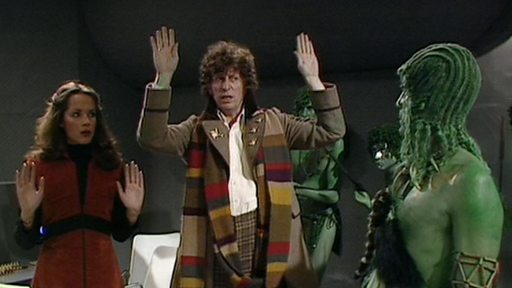
I love this story. I think it is brilliant. The problem is that this story is generally ignored by many people due to the stories which were to come (The Girl in the Fireplace and The Impossible Planet/The Satan Pit) but it is brilliant.

Doctor Who here returns to the style and form of its most prosperous period the Hinchcliffe/Holmes era of the show with its gothic horror vibes permeating the whole story. Action packed from start to end, a brilliant script, an enthralling monster, references to The Horror of Fang Rock (see Toby Hadoke's Who's Round Podcast with RTD to have that explained). A scary monster, clever twists and superb acting. Everyone is on top form this week and I really enjoy the way you just see The Doctor and Rose just having fun, something I think there is an evident lack of in Doctor Who (especially in The Classic Series). This whole story culminates in those dramatic final scenes with the establishment of Torchwood, an organisation which will lead to disastrous ramifications later in the series.

A great story from what could have been the greatest season since the return (if we just remove Love and Monsters, and Fear Her, we would have possibly the best season since the return).

10/10

The Army of Ghosts/Doomsday

Having reviewed The Stolen Earth/Journey's End and noting the various connections to this story, I am going back to the Series Two finale The Army of Ghosts/Doomsday. Firstly I really like the Torchwood set up and wish that RTD had taken this Torchwood further in Series Two and just have them popping up physically every once in a while, instead of a couple of references (like having a Torchwood agent standing in the background of School Reunion or Love and Monsters, reporting in on The Doctor's activities). I loved Tooth and Claw which I am planning to review along with a classic series story coming up soon and this is a good payoff to the ideas established in the climactic moments of Tooth and Claw. All the characters come off well in this story, leading up to a very dramatic conclusions in the final minutes with the revelation of the two monsters in the story. Overall Army of Ghosts is a strong opening episode to this epic series finale.

9/10

It had to be this. RTD wanted every finale to be bigger than the last and after having a massive Dalek empire in the Series One finale, the only way to top it would be to have the Daleks and Cybermen in the second series finale. It is however the ultimate piece of fanfiction. But due to some brilliant direction, great acting and some incredibly moving scenes, this story is so much more than that. With two scenes designed to pull the heartstrings Jackie meets Pete, and Rose's goodbye (the latter to be later ruined by Journey's End). The main problem with this story is that if you bring the two most powerful enemies of The Doctor together in a showdown in this way, you either worsen both (by both unable to destroy the other and going to a stalemate, or both being destroyed by each other) or you totally discredit one (by making them seem totally inferior). RTD chooses the latter and despite the fact the Daleks come off very good in this story, it does start a chain of stories where the Cybermen come across as a bit pathetic (Thank You Neil Gaiman for breaking the curse in Nightmare in Silver). I do like the Cyberman, Earth alliance but there was not enough of this war which had been made prophecy by The Beast and foreshadowed at the start of the story. The ending may seem a bit Deus Ex Machina but it makes a lot of sense and therefore I can forgive that they can just pull all the Daleks into hell (but the TARDIS traveled through the void, so why did it not get affected or even mentioned by anyone). Overall a good finale but with a few flaws (generally due to the Daleks being totally superior to the Cybermen [there was a rumour that a similar story was planned for the season five finale of the classic series but Terry Nation's American Dream of the Daleks prevented such, personally I am glad and anyway I suspect ti would be the other way around with the Cybermen obliterating the Daleks as it was the other way round during the Second Doctor's tenure).

7/10

Overall this climatic series finale scores:

8/10

Thursday, 29 May 2014

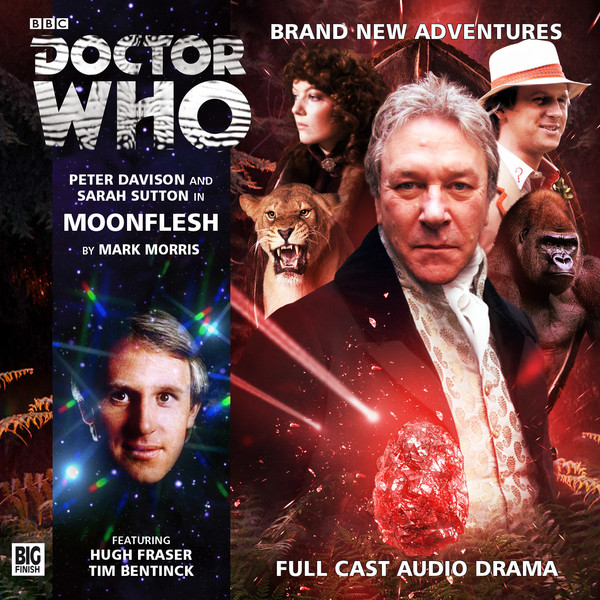
Moonflesh

"Moonflesh" brings together the best Fifth Doctor companion pairing into an idyllic setting alongside a series of interesting and individual characters. When I first saw the cover of this story appear on the Big Finish website I did have my doubts.

"Moonflesh" however was a brilliant listen for me. Walking home on a sunny spring evening with this compelling audio drama being played in my ears was a total joy.

"Moonflesh" is set in 1911 in a country house owned by the eccentric explorer and big game hunter Nathaniel Whitlock (Tim Bentinck) - a man obsessed with the glory of his foreign explorations, surrounding his house with tokens of his success. His daughter Phoebe (Rosanna Miles) has learned her father’s ways, but longs to experience a “proper” life. They have guests for a hunt: the wealthy, obnoxious Edwin Tremayne (Hugh Fraser) and his clumsy, foppish son Hector (Geoffrey Breton). Tremayne and Whitlock would seem to be very similar characters but due to the brilliant acting and effective script they came across as two very well rounded individual characters. Furthermore we have Whitlock’s servant Silver Crow (John Banks), a Native American, totally loyal to Whitlock but reminisces his old life through continuing his tribal rituals - rituals which would become increasingly important the further into the story we progress.

Despite having a cast of traditional stereotypes and a very simple plot, the superb writing, acting and direction make what could be a monotonous listen into a compelling story which makes me desperate to listen what happens next. I may not be the biggest Fifth Doctor fan, but this story is helping me to warm further to The Fifth Doctor.

8/10


Wednesday, 28 May 2014

The Stolen Earth/Journey's End

With such an epic two part story with so much going on it is quite hard to provide a very succinct review but here it goes. The Stolen Earth is actually quite good. The stuff with Martha and UNIT, Captain Jack and Torchwood is really good, and a shame that they are not taken any further. Having a Dalek invasion with attacks on The Valiant is brilliant. Sarah Jane is not totally necessary in this story and the story could work perfectly well without her but Elisabeth Sladen's acting is brilliant though so I am not complaining. Wilf is fantastic in this with his paintball gun. The main problems with this episode is that I do not believe that there is enough of the Dalek invasion but the main problem is Rose. That is what the whole thing is about. I liked Rose is series two (unlike many Doctor Who fans I did not have a problem with that). She is completely unnecessary and the characterisation is completely off  and totally unrecognisable. Overall it is very good and I would score this individually:

7/10

Journey's End is the problem. It is awful. Where do I start. Jackie teleporting in with a massive gun seems totally out of character. Davros is brilliant in the first part but not even Julian Bleach's effortless performance could save it from the awful writing he received, RTD is brilliant writer but this is far from his best work. Rose spends most of the two episodes moaning at Martha being totally selfish and it is awful. The Deus Ex Machina ending is absolutely awful. The Daleks are clever (see the 1960s) they would not have a control panel which can stop all weapons, stop the bomb where they keep prisoners. The overcrowded TARDIS scene is just embarrassing with some awful lines given to members of the cast. Donna being the most important person in human history is unnecessary, there would be other ways of getting around it. Donna's characterisation also seems totally off (even when she is not the Doctor-Donna). The Bad Wolf Bay scene just put the icing on the cake, it ruined a totally brilliant ending in Doomsday. This whole story tainted my opinions of Rose. Finally the Donna ending is just a complete copy of the ending of Jamie and Zoe from The War Games and I was more emotionally affected there than I was here (but that may be because they are two of my all time favourite companions). Enough with the awful parts (I have said that a lot) and onto the few good parts.

Martha and Captain Jack are very good in this, as well as Mickey who has really grown as a character and whereas my opinions of Rose have worsened over time, my opinions of Mickey have done the polar opposite and I love how Martha, Jack and Mickey went off together at the end and it is a shame that RTD did not fulfill his original intentions of Children of Earth to have Martha and Mickey to both feature in it. The scene when Davros spoke to Sarah Jane is mesmerising. There are still lots of other bad things I have not mentioned but I do not want to worsen this story even more by picking it apart any further.

3/10

Overall a promising opening part with only a few small problems but totally discredited by the travesty of what was Journey's End. This is not testament to the brilliant writing of RTD who has and went onto write some absolute crackers (Bad Wolf/Parting of the Ways, Tooth and Claw, Waters of Mars). In summary:

5/10

Tuesday, 27 May 2014

The Shakespeare Code

In the late 1980s script editor Andrew Cartmel highlighted the need to have more historical stories since that was what the BBC did best, unlike the stories set in the future where cardboard and bubble wrap failed to suffice as a convincing alien space station. Despite the fact the BBC now have the money and the technology to produce a convincing alien space station, The Shakespeare Code highlights the fact that the BBC are still very good at this sort of thing.

Having watched Gareth Robert's other RTD story recently 'The Unicorn and the Wasp' I realise that both are ridiculously similar. Both feature references to the featured historical writers work ("you can have that"), there is a series of murders and both are comedies.


With a strong cast, great production values and good direction this story does excel but there is nothing special in this story to make it a classic but it is generally a fun romp and the series needs this after the traumatic events of Doomsday for The Doctor.

7/10

The Doctor's Daughter

A multi layered war story which surprises you from beginning to end. The Doctor's Daughter introduces the brilliant character of Jenny (who is playing the tenth Doctor's daughter but she is the fifth doctor's ... this is very confusing), someone who I do hope that in the future will return to the show. All the characters have lots to do, all playing major roles.

The story does make you question who the real enemies are. We would initially say the Hath (especially after they kidnapped Martha) but as we delve deeper into the story we learn that it is the war-like Cobb, who defines military victory, genocide and peace as the same thing. He is neatly contrasted by The Tenth Doctor's pacifism (the problem is though that with the knowledge we have now of the events of The Day of the Doctor, we realise a lot of what he says in this story is wrong).

There is a very much a classic series vibe to this story with the two warring factions and our heroes being split up, being taken to each others camps (Genesis of the Daleks springs to mind). Donna comes across well in this story as well with her solving the mystery of the war, just leaving the character of Martha. She is personally my favourite companion under RTD but was poorly served by series three, as in all but about two or three stories The Doctor is reminiscing Rose, preventing any proper friendship to come about between them. I am therefore glad for her return in series four with her character being used here to highlight that the Hath are not the monsters of the story. 

The whole story climaxes in an epic final confrontation with hints of the Timelord Victorious starting to show but The Doctor has not gone that far yet and instead uses the pain at the loss of his daughter to establish peace and build up a civilisation based on the values of 'a man who never would'. It is shame that Martha has to leave at the end of the story personally (some may disagree) but I realise that it is necessary for her to go as any further stories would hinder the development of the character of Donna. Overall this seems to me a very strong story but does not have the something which could turn it into a great.

8/10

The Unicorn and the Wasp

The Unicorn and the Wasp is an underrated story from the fourth series of the new series, boasting some brilliant performances, layered characters and an idyllic setting. It tells a traditional murder mystery story with the twist (or should I say a sting).

I really like the setting and how the 1920s have been portrayed here and that all the guest cast have important dramatic functions, serving as vehicles which motivate the clues to unlocking the truth. The Doctor and Agatha Christie work very well together here but this is itself the problem of the story. Donna. Donna serves very little dramatic function in this story and generally becomes quite annoying in a number of scenes. Agatha Christie acts more like a companion than Donna does and therefore Donna is pushed to the sidelines where she is either moaning about running towards a wasp, killing the tension built up in the revelation scene or just being frankly annoying. This is by far one of the characters worse stories. This story would have worked much better as a companion-lite story with Agatha Christie filling in the role of the companion.

Apart from that a silly eating scene and over-excessive comedy, this is a good story. Murder mystery stories have generally been a great success for Doctor Who in the past (Robots of Death) but due to a few problems here, this story is limited to just another good story, despite the excellent production values.

6/10

Monday, 26 May 2014

Doctor Who Legacy Reviewed

Doctor Who has generally failed to produce a successful game to play in the past. With Doctor Who: The Adventure Games being cancelled it appeared that there was never going to be a great Doctor Who game.

We were wrong. Last November, a new game was produced and is now a massive hit - Doctor Who Legacy. It is essentially a puzzle game but as you progress through the levels it becomes increasingly strategy based. You get to build up a team which you use to fight Cybermen, Sontarans, Weeping Angels, Daleks and the main enemy (spoilers).

The game is constantly being updated with new characters, monsters, levels and now the perk system which has added a whole new dimension to the game, enhancing the strategy side of the game which I hinted at earlier. And most importantly it is free! You do not have to spend any money to play the game but you are able to unlock the fan area which enables the players to play bonus levels and collect bonus characters which enables the makers to continue making the game and producing more levels, but is not necessary for ones enjoyment (we do urge you to get it though - all you need to do is buy six or more time crystals in the store). All doctor who fans need to get this!

One of the two best elements of the game is firstly how you are able to build up a team from any number of characters of the show. So you can have your favourite Doctor and your favourite companions fight your favourite enemies. I personally design teams around eras and strategy so at present I have an Eleventh Doctor team (11, Clara, River, Lorna Bucket, Amy, Handles) and a Tenth Doctor team (10, Martha, Jenny, Sarah Jane, Captain Jack, Yellow Ood), alongside my other more strategy based teams.

Secondly is the way that the designers interact with Doctor Who fandom. Every Thursday night on Adipose TV on Twitch there is a two hour feed where the presenter (Adi) and the producers (Lee and Susan) discuss everything which is coming up in the near future in the game and listen and respond to fan questions on the sorts of characters, monsters and improvements fans want for the game and improve the game as a result to favour fan enjoyment. Furthermore their facebook page is constantly being updated with news and special promo codes for extra characters.

This game is incredible and urge everyone to play it (despite the fact I suspect everyone already is) and on the sister site Doctor Who News will try to update you when any news on future developments are announced along with our daily updates. Normally I score everything here out of ten but this gets a special score:

11/10


The Fires of Pompeii

The Fires of Pompeii (Or a multi doctor story featuring The Twelfth Doctor (using the fob watch) and Klein, The Eleventh Doctor (working from the sidelines) and Amy (posing as a soothsayer), The Tenth Doctor and Donna).

The story itself is really strong with only a few historical inaccuracies (not talking about the Pyroviles and the volcano) for example Caecilius was actually a banker not a stone sales man. Apart from that it is a strong story with a very large cast but due to skilled writing and direction the story does not feel overcrowded. There are a lot of great character moments especially with the guest cast building up to those epic final scenes with Donna in the TARDIS and The Doctor saving Caecilius. Additionally the special effects in this story are very good (probably some of the best CGI of the RTD era with the eruption). THe story is very good but there is something missing from it which limits it. It needed something else (possibly more time, I do not know) to turn this into a great story.

7.5/10


Monday, 17 February 2014

Doctor Who - Bad Wolf/Parting of the Ways

Bad Wolf and Parting of the Ways

I have recently been watching the entirety of Series One recently and I have just come to the finale (reviews of the previous eight episodes to come soon). The Bad Wolf theme has been built up throughout the series and personally I far prefer the current more complicated story arcs. The Bad Wolf story arc just seems a bit to simple, but at least this season has a story arc (there is one in season two, a couple of references in season three but season four the arc is just about bee's disappearing and a couple of pictures of Rose). Now onto the actual story. At first before you understand what is actually going on, I do not really know what to think of the story. Whilst the three protagonists are stuck inside the game shows this story could have gone either way. Luckily Russel T Davies wrote another cracker. There are a couple of nice references to the classic series weaved in (The Lunar Penal Colony - Frontier in Space). The last ten minutes of Bad Wolf are electric and The Ninth Doctor is mesmerizing in his end speech to The Daleks. Parting of the Ways is brilliant. The Daleks are just as threatening here as they were back in Dalek. They are an unstoppable force. This, Dalek and Asylum of the Daleks, are the reasons why this monster is claimed the greatest monster of all time. The Ninth Doctor gets a brilliant send off here and the story does seem fitting for his era. In summary, a cracking finale for The Ninth Doctor's era and just makes me sad that it ends. 10/10